Fleurs du Mal Magazine


Fleur Jaeggy: Die letzten Tage von Ingeborg. Ingeborg Bachmann aus nächster Nähe – bewegende Szenen einer Freundschaft
Fleur Jaeggy erinnert sich an Ingeborg Bachmann, ihre Weggefährtin, langjährige Freundin, an das viele, viel zu wenige gemeinsame Leben, an lichte, unbeschwerte Nähe und an das schwere Ende Ingeborgs. Und Fleur Jaeggy breitet diese Erinnerungen so aus, wie nur sie es kann, schonungslos anschaulich, in zärtlicher Lakonie.
 Im Sommer 1971 fahren die beiden in einem roten Alfa Romeo von Rom aus an die toskanische Küste. Der Plan ist einfach: einen Monat zusammen verbringen, keine Briefe, keine Anrufe, Meer, Sonne. Sie gehen täglich schwimmen, reden bis tief in die Nacht. Italo Calvino kommt zu Besuch, Uwe Johnson schaut vorbei, aber eigentlich sind sie so innig, dass sie niemanden sonst sehen wollen. Nur knapp zwei Jahre später stirbt Ingeborg Bachmann und Fleur Jaeggy bleibt in tiefer Trauer zurück.
Über fünfzig Jahre nach dem viel zu frühen Tod Ingeborg Bachmanns schreibt Fleur Jaeggy dieses sehr private Buch. Die letzten Tage von Ingeborg ist eine Hommage in drei Akten: Es sind Erinnerungen an sonderbar mäandernde Gespräche, Leberwurstessen, Reisen nach Klagenfurt und Wien; es sind Reflexionen über das Altern; vor allem aber ist es das schmerzhafte Protokoll der letzten Tage von Ingeborg Bachmanns Leben im Zentrum für Brandverletzte Sant’Eugenio in Rom. Fleur Jaeggy war bis zuletzt an ihrer Seite.
Fleur Jaeggy ist eine schweizerische und italienischsprachige Autorin, Ex-Model, Intellektuelle, Mystikerin, inzwischen etwas über 80 Jahre alt, ehemals enge Vertraute Ingeborg Bachmanns, Witwe des Adelphi-Verlegers Roberto Calasso, heute lebt sie weitgehend zurückgezogen in Mailand. Ihr weltweit gefeiertes Werk umfasst Romane, Erzählungen und Geschichten – beginnend mit Ich bin der Bruder von XX, wird es fortan vollständig im Suhrkamp Verlag erscheinen.
Ingeborg Bachmann, geboren am 25. Juni 1926 in Klagenfurt, wurde durch einen Auftritt vor der Gruppe 47 als Lyrikerin bekannt. Nach den Gedichtbänden Die gestundete Zeit (1953) und Anrufung des Großen Bären (1956) publizierte sie Hörspiele, Essays und zwei Erzählungsbände. Malina (1971) ist ihr einziger vollendeter Roman. Bachmann starb am 17. Oktober 1973 in Rom.
Fleur Jaeggy
Die letzten Tage von Ingeborg.
Ingeborg Bachmann aus nächster Nähe –
bewegende Szenen einer Freundschaft
Barbara Schaden (Übersetzung Ital.)
Deutsche Erstausgabe
Suhrkamp Verlag GmbH
Hardcover
44 pag.
ISBN-10: 3518433296
ISBN-13: 978-3518433294
Erscheinungstermin: 24.07.2026
16,00 Euro
• fleursdumal.nl magazine
More in: #Editors Choice Archiv, Archive A-B, Archive A-B, Bachmann, Ingeborg, Celan, Paul

Francis Rose
Shut up
And stay shut
Where they drink all the better
For families of yet get her
With them in ravishes
Between them with dishes
And they came then with her
In precious labor with love
He may yet get wealth in getting tender
Which they make stronger
With us
Thank you.
How many cakes make jell for jelly
And how many loves make bless
A little flower of rather think better embellishment.
Just why join mass
A mass is a towing to a lock.
At towed they devise
How to a challenge.
Challenge has nothing to do with him.
How are heads held Howard.
She cooked and seized.
Cooked and seized
She cooked and seized.
Forbearance
Cooked and seized.
Bridle is paths.
Just as about a path
Just as a path
Just as a path.
It makes no difference whether four
Ate one.
Sum to sum.
Our adding is more hours.
Ate one
Just as well ate one
Just as well eight one
Just as well eight
One just as well
Eight one.
How much are they like me
Like.
After walked.
Before walked
He made her talk
To have her
Walk
After walked
And leave a walk
Leave walk
Or leave her leave walked.
It is an error
Oh.
Join me
With observation
She may be
Our hour glass
Which we sought
And have not bought
For our hour be
Be an hour for me.
Such is sought
And here bought
For our be
Her be
Err be
Come Francis Rose
Or be
Forty leave fifteen
Thrilled be
Or sought by
It for him
Or for
Her
For him to be
When they may
They may
Shall shelter
They make
Shelter
As they may be
For and to be
Nobody knows how old showers are.
Or how should hours should be.
In inlay should be
That with mean
With be
With held will then
In to be.
What is a square.
Gertrude Stein
(1874 – 1946)
Francis Rose
• fleursdumal.nl magazine
More in: Archive S-T, Archive S-T, FDM in Paris, Gertrude Stein, Modernisme, Stein, Gertrude

The End Of Fear
Though the whole heaven be one-eyed with the moon,
Though the dead landscape seem a thing possessed,
Yet I go singing through that land oppressed
As one that singeth through the flowers of June.
No more, with forest-fingers crawling free
O’er dark flint wall that seems a wall of eyes,
Shall evil break my soul with mysteries
Of some world-poison maddening bush and tree.
No more shall leering ghosts of pimp and king
With bloody secrets veiled before me stand.
Last night I held all evil in my hand
Closed: and behold it was a little thing.
I broke the infernal gates and looked on him
Who fronts the strong creation with a curse;
Even the god of a lost universe,
Smiling above his hideous cherubim.
And pierced far down in his soul’s crypt unriven
The last black crooked sympathy and shame,
And hailed him with that ringing rainbow name
Erased upon the oldest book in heaven.
Like emptied idiot masks, sin’s loves and wars
Stare at me now: for in the night I broke
The bubble of a great world’s jest, and woke
Laughing with laughter such as shakes the stars.
Gilbert Keith Chesterton
(1874 — 1936)
The End Of Fear
• fleursdumal.nl magazine
More in: Archive C-D, Archive C-D, Chesterton, Gilbert Keith, G.K. Chesterton
In memoriam Lieke Marsman (1990-2026)
Op 3 juni 2026 is dichter, filosoof en romancier Lieke Marsman op 35-jarige leeftijd overleden. Zij leed aan een zeldzame vorm van kanker.
Lieke Marsman (’s-Hertogenbosch 1990 – Parijs 2026) debuteerde in 2010 met de dichtbundel ‘Wat ik mijzelf graag voorhoud.’ Daarvoor won ze meteen de C. Buddingh’-prijs, de Lucy B. en C.W. van der Hoogtprijs en de Liegend Konijn Debuutprijs. Drie jaar later verscheen ‘De eerste letter’.
 In 2017 publiceerde Lieke Marsman haar roman ‘Het tegenovergestelde van een mens’, door NRC uitgeroepen als een van de beste boeken van deze eeuw. Hierin vervlecht ze proza met poëzie en essayistiek om een groot en actueel thema van deze tijd te kunnen belichten: klimaatverandering. In 2017 verscheen eveneens ‘Man met hoed’, een bundel verzamelde gedichten, waarin ook vertalingen van haar hand zijn opgenomen. In ‘De volgende scan duurt vijf minuten’ (2018) onderzoekt Lieke Marsman in tien gedichten en een essay hoe een ziek lichaam zich verhoudt tot een zieke wereld. Het is een vurig pleidooi dat oproept om je heen te kijken en je maatschappelijke verantwoordelijkheid te nemen in een gepolariseerde samenleving.
Op de dag van haar benoeming tot Dichter des Vaderlands verscheen ‘In mijn mand’ (2021), waarin Lieke Marsman de grootste thema’s behandelt die het menselijke bestaan kenmerken: de waarde van het leven en de plek die de dood daarin inneemt. Marsman bekleedde de positie van Dichter des Vaderlands tot 2023. Begin 2023 verscheen haar bundel ‘Ter gelegenheid van poëzie’, een ode aan de poëzie en het belang van het nauwkeurig gebruiken van de taal, gericht en oprecht. In het publieke debat bracht ze dit in de praktijk. Als essayist in de krant en kernachtig op sociale media was Lieke Marsman een zeer maatschappelijk betrokken commentator. Met humor en scherpte wist ze altijd tot de kern van complexe vraagstukken door te dringen.
In 2025 werd ‘Op een andere planeet kunnen ze me redden’ gepubliceerd. Dit boek is een filosofische trip tot in de diepten van de menselijke geest, afgewisseld met dagboekfragmenten die beschrijven hoe de dood Marsman op de hielen zit. Ook werd haar de Constantijn Huygens-prijs toegekend voor haar gehele oeuvre.
Op 9 juni 2026 verscheen Marsmans laatste boek, ‘De dichter en de duivel.’
Een dichter koopt een huis en komt tot de ontdekking dat haar berging toegang biedt tot een ondergrondse wereld waar mensen in ruil voor kleine stukjes ziel hun zonden afkopen. Terwijl ze steeds verder afdaalt, ontmoet ze influencers, politici, opiniemakers en columnisten. Gelukkig is er zo nu en dan een dichter die soelaas biedt, maar uiteindelijk mondt de reis uit in het onvermijdelijke: ze komt oog in oog met de duivel te staan.
Lieke Marsman
De Dichter en De Duivel
Hardcover
Nederlands
9 juni 2026
120 pagina’s
Uitgeverij Pluim
EAN 9789493525146
€ 24,99
Is het mijn sterfdag?
De lucht is stil, als lucht
op een kalender
Is het mijn sterfdag?
Vergeet klokken die luiden
De lucht is stil, als lucht
Is het mijn sterfdag?
Vergeet engelen en psalmen
Ik wil het vanille van een oud boek
Ik wil een koud flesje bier
en ik wil jou, nog één keer
Vergeet de vogels die zingen
Ik wil mijn hond horen drinken
Uit: ’In mijn mand’ (Uitgeverij Pluim, 2021)

• Foto: Wikipedia/Coen Peppelenbos 2014
• fleursdumal.nl magazine
More in: (Terminal) diseases, - Archive Tombeau de la jeunesse, - Book News, - Bookstores, Archive M-N, Archive M-N, In Memoriam, Lieke Marsman, Marsman, Lieke
“One of my generation’s finest poets—a truly peerless voice. . . . An immense book and a searing achievement.” —Ocean Vuong, author of The Emperor of Gladness
The stunning third collection from award-winning poet Maya C. Popa dramatizes the paradox of correspondence: the private worlds shaped by the act of writing, and the charged silences that follow.
 Drawing from nineteenth-century courtship letters, the collection lingers in the rush of love and its fallout: “Happiness was no small thing, / but neither was its cost.” Delivered with piercing elegance and signature wit—“What a formidable excuse he was. / What a pair of borrowed eyes / with a side of Keats”—these poems remind us that our appetites, like poetry, depend on revelation and restraint alike.
Set in America, England, and Romania, these poems are part elegy to the passing of impossible things, part ars poetica of remaking. If You Love That Lady explores the inventive, relentless drive of longing, proving that what breaks us open at last reveals us to ourselves.
From “Dark Matter”:
Desire’s what’s the matter
with our lives, a sea parting
to reveal another sea.
Its command renews,
swells and beckons:
you’d be a fool not to love
until the last second.
Maya C. Popa is the author of If You Love That Lady, forthcoming from W.W. Norton and Picador in 2026. Her previous collections include Wound is the Origin of Wonder (W.W. Norton 2022; Picador 2023), named one of the Guardian’s Best Books of Poetry. American Faith (Sarabande 2019) was runner-up in the Kathryn A. Morton Prize judged by Ocean Vuong and was awarded the North American Book Prize in 2020. She has received awards from the Poetry Foundation and the Oxford Poetry Society among others. Popa holds a PhD on the role of wonder in poetry from Goldsmiths, University of London, where she was a recipient of a department bursary for exceptional merit, and previous degrees from Oxford University, NYU, and Barnard College. Maya is the Poetry Reviews Editor at Publishers Weekly and is the founder of Conscious Writers Collective, where she teaches and oversees all literary programming for poets and prose writers.
If You Love That Lady.
Poems
Author: Maya C. Popa
English
Available for Sale: 14/07/2026
Hardcover
Price €34,00
ISBN 978-1-324-12456-6
80 pages
Publ.: W.W. Norton and Picador
• fleursdumal.nl magazine
More in: Archive O-P, Archive O-P, Popa, Maya C.
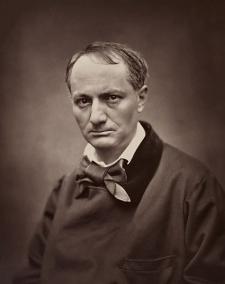
À celle qui est Trop Gaie
Ta tête, ton geste, ton air
Sont beaux comme un beau paysage ;
Le rire joue en ton visage
Comme un vent frais dans un ciel clair.
Le passant chagrin que tu frôles
Est ébloui par la santé
Qui jaillit comme une clarté
De tes bras et de tes épaules.
Les retentissantes couleurs
Dont tu parsèmes tes toilettes
Jettent dans l’esprit des poètes
L’image d’un ballet de fleurs.
Ces robes folles sont l’emblème
De ton esprit bariolé ;
Folle dont je suis affolé,
Je te hais autant que je t’aime !
Quelquefois dans un beau jardin
Où je traînais mon atonie,
J’ai senti, comme une ironie,
Le soleil déchirer mon sein ;
Et le printemps et la verdure
Ont tant humilié mon coeur,
Que j’ai puni sur une fleur
L’insolence de la Nature.
Ainsi je voudrais, une nuit,
Quand l’heure des voluptés sonne,
Vers les trésors de ta personne,
Comme un lâche, ramper sans bruit,
Pour châtier ta chair joyeuse,
Pour meurtrir ton sein pardonné,
Et faire à ton flanc étonné
Une blessure large et creuse,
Et, vertigineuse douceur !
A travers ces lèvres nouvelles,
Plus éclatantes et plus belles,
T’infuser mon venin, ma soeur !
Charles Baudelaire
(1821 – 1867)
À celle qui est Trop Gaie
Extrait de: Les fleurs du mal (1857)
(Flowers of Evil)
• fleursdumal.nl magazine
More in: Archive A-B, Archive A-B, Baudelaire, Charles, Les Fleurs du Mal

Vachel Lindsay
Meeting Ourselves
We met ourselves as we came back
As we hiked the trail from the north.
Our foot-prints mixed in the rainy path
Coming back and going forth.
The prints of my comrade’s hob-nailed shoes
And my tramp shoes mixed in the rain.
We had climbed for days and days to the North
And this was the sum of our gain:
We met ourselves as we came back,
And were happy in mist and rain.
Our old souls and our new souls
Met to salute and explain—
That a day shall be as a thousand years,
And a thousand years as a day.
The powers of a thousand dreaming skies
As we shouted along the trail of surprise
Were gathered in our play:
The purple skies of the South and the North,
The crimson skies of the South and the North,
Of tomorrow and yesterday.
Vachel Lindsay
(1879 – 1931)
Meeting Ourselves
• fleursdumal.nl magazine
More in: Archive K-L, Archive K-L, Lindsay, Vachel

When We Two Parted
When we two parted
In silence and tears,
Half broken-hearted
To sever for years,
Pale grew thy cheek and cold,
Colder thy kiss;
Truly that hour foretold
Sorrow to this.
The dew of the morning
Sunk chill on my brow—
It felt like the warning
Of what I feel now.
Thy vows are all broken,
And light is thy fame;
I hear thy name spoken,
And share in its shame.
They name thee before me,
A knell to mine ear;
A shudder comes o’er me—
Why wert thou so dear?
They know not I knew thee,
Who knew thee too well—
Long, long shall I rue thee,
Too deeply to tell.
In secret we met—
In silence I grieve,
That thy heart could forget,
Thy spirit deceive.
If I should meet thee
After long years,
How should I greet thee?—
With silence and tears.
George Gordon, Lord Byron
(1788-1824)
When We Two Parted
• fleursdumal.nl magazine
More in: - Archive Tombeau de la jeunesse, Archive A-B, Archive A-B, Byron, Lord

Der Spruch
In einem alten Buche stieß ich auf ein Wort,
Das traf mich wie ein Schlag und brennt durch meine Tage fort:
Und wenn ich mich an trübe Lust vergebe,
Schein, Lug und Spiel zu mir anstatt des Wesens hebe,
Wenn ich gefällig mich mit raschem Sinn belüge,
Als wäre Dunkles klar, als wenn nicht Leben tausend wild verschlossne Tore trüge,
Und Worte wiederspreche, deren Weite nie ich ausgefühlt,
Und Dinge fasse, deren Sein mich niemals aufgewühlt,
Wenn mich willkommner Traum mit Sammethänden streicht,
Und Tag und Wirklichkeit von mir entweicht,
Der Welt entfremdet, fremd dem tiefsten Ich,
Dann steht das Wort mir auf: Mensch, werde wesentlich!
Ernst Stadler
(1883 – 1914
Der Spruch
• fleursdumal.nl magazine
More in: *War Poetry Archive, - Archive Tombeau de la jeunesse, Archive S-T, Ernst Stadler, Leïla Slimani, Modernisme, Stadler, Ernst

Release
With swift
Great sweep of her
Magnificent arm my pain
Clanged back the doors that shut my soul
From life.
Adelaide Crapsey
(1878—1914)
Release
• fleursdumal.nl magazine
More in: #Editors Choice Archiv, - Archive Tombeau de la jeunesse, Archive C-D, Archive C-D, Crapsey, Adelaide

A Musical
Outside the rain upon the street,
The sky all grim of hue,
Inside, the music–painful sweet,
And yet I heard but you.
As is a thrilling violin,
So is your voice to me,
And still above the other strains,
It sang in ecstasy.
Paul Laurence Dunbar
(1872—1906)
A Musical
• fleursdumal.nl magazine
More in: # Music Archive, *Archive African American Literature, - Archive Tombeau de la jeunesse, Archive C-D, Archive C-D, Dunbar, Paul Laurence, Dunbar, Paul Laurence, Paul Laurence Dunbar

Song of the Old Love
When sparrows build, and the leaves break forth,
My old sorrow wakes and cries,
For I know there is dawn in the far, far north,
And a scarlet sun doth rise;
Like a scarlet fleece the snow-field spreads,
And the icy founts run free,
And the bergs begin to bow their heads,
And plunge, and sail in the sea.
O my lost love, and my own, own love,
And my love that loved me so!
Is there never a chink in the world above
Where they listen for words from below?
Nay, I spoke once, and I grieved thee sore,
I remember all that I said,
And now thou wilt hear me no more – no more
Till the sea gives up her dead.
Thou didst set thy foot on the ship, and sail
To the ice-fields and the snow;
Thou wert sad, for thy love did naught avail,
And the end I could not know;
How could I tell I should love thee to-day,
Whom that day I held not dear?
How could I know I should love thee away
When I did not love thee anear?
We shall walk no more through the sodden plain
With the faded bents o’erspread,
We shall stand no more by the seething main
While the dark wrack drives o’erhead;
We shall part no more in the wind and the rain,
Where thy last farewell was said;
But perhaps I shall meet thee and know thee again
When the sea gives up her dead.
Jean Ingelow
(1820 – 1897)
Song of the Old Love
Published in 1898
•fleursdumal.nl magazine
More in: # Classic Poetry Archive, Archive I-J, Archive I-J
Thank you for reading Fleurs du Mal - magazine for art & literature